Chapter One
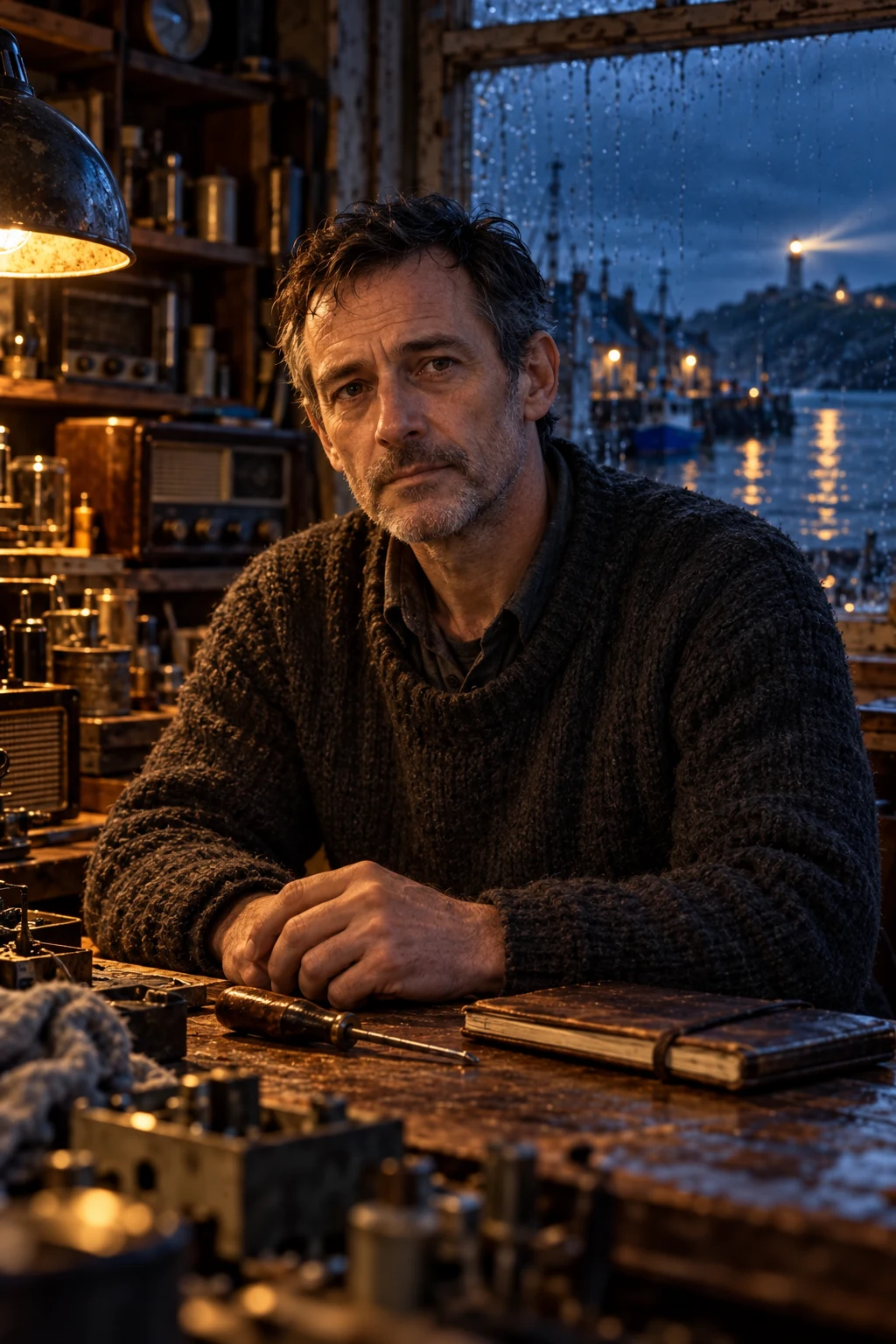
3:17 AM The Grundig had a fault somewhere in the intermediate frequency stage, and Owen Ward had been looking for it for the better part of two hours.
He sat at his workbench with a small screwdriver held between two fingers and a jeweller’s loupe pressed to his eye, turning a trimmer capacitor by increments so small they might have been imaginary. The workshop was quiet in the way workshops are quiet after midnight — not silent, because silence is rare on the harbour, but settled. The rain had started around eleven and hadn’t changed its mind. It came off the water at an angle, steady and purposeful, and struck the workshop’s narrow windows in the same arrhythmic pattern it always did.
Owen did not find the fault.
He set the screwdriver down, pushed the loupe up to his forehead, and studied the Grundig’s exposed chassis without touching it. The set was a 1961 model, brought in by a man from Dunmore who had found it in his mother’s attic and wanted it working again for reasons he didn’t fully explain. Owen had quoted him three weeks and taken a deposit. That had been seven weeks ago.
The capacitor was probably fine. He was probably looking in the wrong place.
He stood and moved to the kettle without thinking about it — the movement automatic, worn smooth by repetition. While the water heated he looked at the workbench from across the room, which sometimes helped. Twelve radios in various states of repair occupied the shelves along the east wall. Valve sets mostly, with a few transistor models from the sixties and a German shortwave receiver someone had dropped off last March and never collected. The room smelled of solder and machine oil and the faint mineral sharpness that old electronics develop over decades, a smell Owen could no longer really notice but that he would have missed immediately if it were gone.
He made the tea. He stood at the window with it and looked at what little of the harbour was visible through the rain.
The dock lights were on. They were always on. A fishing boat he didn’t recognise was moored at the far end, its rigging tapping softly against the mast in the wind. The foghorn sounded from somewhere out past the point — a low, unhurried note that arrived on a slight delay from the fog it announced. Everything was where it should be. Everything was doing what it did.
Owen turned back to the workbench.
He didn’t check the time. He rarely did, this late. The hour stopped mattering around midnight and didn’t start again until the light changed.
***
He found the fault at twenty past something. A hairline crack in a solder joint at the base of the first IF transformer, visible only when he changed the angle of the work lamp and the shadow fell across it differently. He cleaned the joint, resoldered it, and ran the set through a basic alignment. The Grundig came to life producing a clear, clean signal — a night broadcast from somewhere he didn’t bother to identify, a man reading something slowly, weather or shipping or news.
He switched it off.
Around him the other radios were quiet. He preferred them quiet when he was working, and had for so long now that he could barely remember filling the workshop with sound the way he once had — radio stations, shortwave traffic, weather services, the overnight programmes that ran from midnight until the early presenters arrived. Eleven years was long enough for a preference to stop feeling like a choice. It had simply become how he worked.
He moved the Grundig to the completed shelf. Wrote up the job in his ledger with the time and a note about the fault. Capped his pen.
The clock on the wall — an old schoolroom clock with a white face and a loud second hand — read 3:14.
He should go up to the house. He knew this. The house was thirty feet from the workshop door, across a small courtyard that would be wet. He had been sleeping poorly for the better part of eleven years and sleeping on the workshop couch more often than he should, which was not good for him — the couch was too short and his back was beginning to register the insult. He was fifty-three years old. He needed to sleep in a bed.
He didn’t move.
3:15.
The rain shifted slightly, coming now from a different angle, and the sound of it against the windows changed register. Outside, the foghorn again. The rigging on the unknown fishing boat.
Owen sat back down on his stool and looked at the Grundig on the completed shelf for a while. He thought about the man from Dunmore who hadn’t called to collect it. He thought about whether he should call the number in his ledger or wait another week. He thought about whether it was worthwhile realigning the German shortwave receiver that had been sitting uncollected since March, just to keep his hands busy, just to stay current with the technique.
He was not thinking about anything else.
3:16.
He reached for the screwdriver — not because there was anything to do with it, but because holding a tool was better than not holding one — and turned it between his fingers the way he did when he was reading something, or listening, or waiting without knowing what he was waiting for.
The lighthouse beam came through the window on its rotation. A slow white sweep across the east wall. Gone.
The hum of the transformer in the corner.
The second hand of the clock.
The rain.
3:17.
Every radio in the workshop sounded at once.
Not a broadcast. Not a frequency. A single pulse of static that came from all of them simultaneously — the sets on the completed shelf, the sets in for repair, the German shortwave, the small transistor radio he kept on the windowsill — all of them, though none of them were powered. The sound lasted perhaps two seconds and then stopped with a completeness that was itself strange, a silence that felt deliberate rather than natural.
Owen did not move.
His hand was still on the screwdriver. The tea was cold on the bench beside him. The rain continued exactly as before, striking the windows in the same arrhythmic pattern.
He waited.
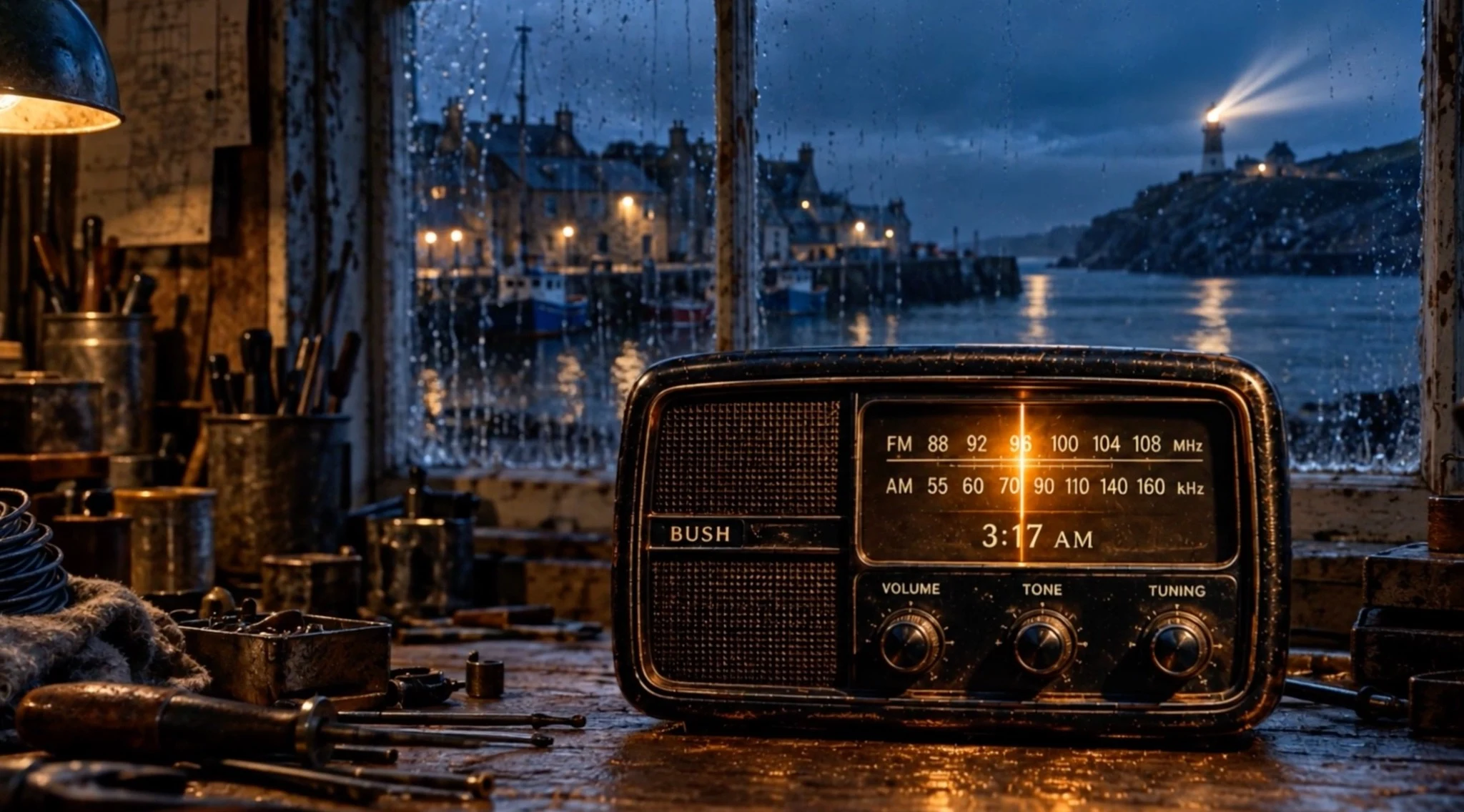
One of the radios on the repair shelf — an old valve set, a Bush from the early sixties, not yet assessed — began, very slowly, to power on. He could hear it the way you hear a valve set warming: a low, gradual hum, the click of the circuit settling, a faint carrier wave rising under the noise.
He had not touched it. It was not connected to the mains. The power cable was coiled on the shelf beside it, unattached.
Owen put the screwdriver down.
He stood without making a decision to stand — his body making the movement before his mind could debate it — and he looked at the Bush radio from across the workbench. The dial was not illuminated. There was no reason for the carrier wave. There was no reason for any of it.
The static grew.
It was not the static of a poor signal or a weak transmitter. It had a texture he couldn’t identify — layered, almost rhythmic, as though it were composed of something rather than produced by interference. He had worked with radio for thirty years. He knew static. This was doing something that static did not do.
He took two steps toward it.
The sound shifted.
Beneath the static — or inside it, or arriving through it, the spatial relationship was wrong, he could not locate the sound in the room the way he could normally locate a sound — beneath or inside or through it, a voice.
A girl’s voice.
Weak. Remote. Struggling through the interference the way a voice struggles through a bad connection, present but unstable, words arriving and then losing shape before they completed.
“Dad—”
The word was unmistakable. One syllable, recognisable not just as language but as a voice he knew.
Owen Ward stopped.
The blood moved differently in him for a moment. Or the air did. Something physical changed in the workshop that he would not be able to describe or account for later, a change in pressure or temperature or the quality of the light, something that his body registered before his mind could name it.
The static breathed.
“Dad. Can you hear me?”
He stood between the workbench and the shelf, arms at his sides. For a moment he could not tell whether he was breathing.
The voice was Clara’s.
He knew it as precisely and completely as he knew anything. There was no ambiguity. There was no question of misidentification or mishearing or the pareidolia of grief that his doctor had once, very carefully, raised as a possibility. This was not his mind finding a familiar voice in random noise. This was a voice. Her voice. The particular quality of it — a habit of trailing certain syllables, the way she said the word Dad with the emphasis weighted toward the front of it, the sound of his daughter addressing him — was absolutely precise.
And wrong, in a way he could not yet name. A child’s voice carrying something that did not belong to a child. He would not understand for some time that this was the first thing he noticed and the last thing he let himself believe.
Clara Ward had been twelve years old when she disappeared from the shoreline below the harbour, eleven years ago come March.
“I—” The voice broke. Static surged across it. “I can’t stay—”
The carrier wave collapsed.
Every radio in the room went silent at the same moment, and this time the silence was total — the hum of the transformer was gone, the last trace of the carrier wave was gone, even the acoustic presence of the room seemed to dim for a moment, as though the workshop itself had held its breath and then released it.
Only the rain remained.
Owen stood in the middle of the room.
Outside, the foghorn sounded from beyond the point. The lighthouse beam came through the window on its rotation. A slow white sweep across the east wall.
He looked at the Bush radio on the shelf. The dial was dark. The power cable was coiled beside it, unattached to anything.
He became aware, slowly, that he was holding the edge of the workbench with both hands.
He let go of it.
At some point he sat down on the stool.
At some point he looked at his hands.
The radio remained dark.
Owen sat until daylight came through the harbour windows. He did not sleep. He did not move. He did not go up to the house.
Eleven years. No body. No answer. And now, for the first time since the night she had walked down to the shoreline and not walked back, something resembling one.
End of Chapter One
Return to the world